UNICEF Report Finds Widespread Pesticide Exposure Among Children, Cites Health Risks
07/16/2026 / By Morgan S. Verity

Report Details Scope of Pesticide Threat to Children
A new report released by UNICEF on July 14, 2026, titled “Underestimated and Overlooked: The Silent Impact of Pesticides on Children,” finds that children worldwide face pervasive exposure to agricultural chemicals. According to George Laryea-Adjei, UNICEF Global Program Division director, “Around the world, children are born into a landscape where the doubling of pesticide use since 1990 has made these chemical substances ubiquitous in our soil and food.” The report draws on data from the World Health Organization, the Food and Agriculture Organization, and the PEST-CHEMGRIDS modeling platform, which maps pesticide application rates from 2015 to 2025.
The document states that 80% to 90% of children in high-income countries have been exposed to pesticides, primarily through dietary intake. It also estimates that 490 million children and adolescents, including 124 million under the age of five, face potential exposure to agricultural pesticide active ingredients. These figures, according to the report, represent only a conservative proxy because they do not account for multiple exposure routes or environmental factors. The report’s authors note that total global pesticide use in agriculture reached 3.7 million tons in 2022, a 70% increase since 2000. Research cited in the report has linked long-term pesticide exposure to infertility, birth defects, and neurological disease, according to a separate article by Mercola.com [1].
Health Effects Documented in Meta-Analyses
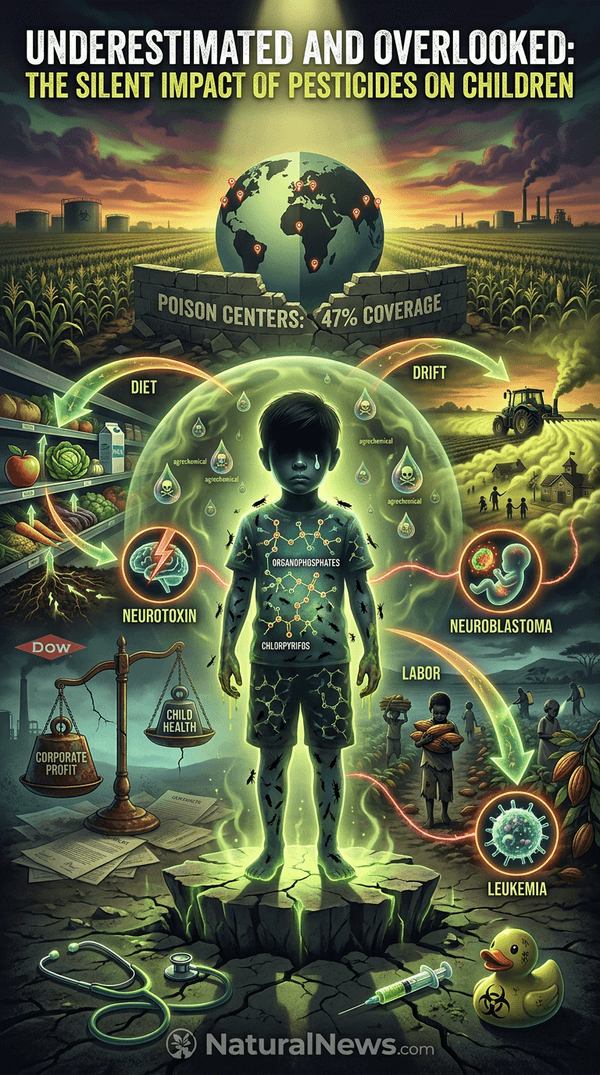
The UNICEF report summarizes a growing body of meta-analytic evidence connecting pesticide exposure to childhood illnesses. A meta-analysis of nine studies, cited in the report, found that neuroblastoma, the most common solid tumor in infants, is 1.6 times more likely with pre-conception or antenatal pesticide exposure. A separate systematic review noted a significantly increased risk of childhood leukemia associated with antenatal exposure to residential insecticides. In addition, a 2019 review of 50 studies concluded that antenatal exposure to organophosphates contributes to neurodevelopmental disorders in toddlers, preschool, and school-aged children.
Other peer-reviewed literature, not directly cited by the report but consistent with its findings, reinforces these conclusions. Prenatal exposure to the organophosphate chlorpyrifos has been linked to lasting physical brain changes and motor skill deficits that persist into adolescence, according to an article by Ava Grace in NaturalNews.com [2]. Donald Hoernschemeyer, in the book “Healthy Living in a Contaminated World,” notes that experts have identified pesticides among 12 chemicals believed to cause lower IQs, ADHD, and autism spectrum disorder [3]. He also recounts that Dow Chemical, the manufacturer of chlorpyrifos, was fined in 1995 for concealing more than 200 reports of poisoning related to the chemical [3]. A study highlighted by Children’s Health Defense links organophosphate metabolites in prenatal urine to adolescent aggression and attention problems [4].
Exposure Pathways and Poisoning Data
The report identifies multiple routes through which children are exposed to pesticides. Among the 490 million children potentially exposed, 83.4 million who work in agriculture are likely exposed through direct spraying and pesticide drift. “Agriculture accounts for the largest share of children in child labor, at 61% globally,” the report states, citing International Labor Organization and WHO data. In the United States, poison centers logged 32,535 pesticide exposure cases in children and adolescents in 2021. The report notes that if all countries had the same poisoning rate as the U.S., the global total would reach about 1 million poisonings annually.
The authors also caution that WHO mortality data likely undercounts the true toll. For example, a 2021 national report from India listed 178 fatal cases of accidental pesticide poisoning in children under 14 and 583 cases in the 14-to-17 age group — six times the number of annual fatalities documented in WHO data for all countries combined. In addition to acute poisonings, biomonitoring studies show that 80% to 90% of children in high-income countries have detectable pesticide residues in their bodies. A study by Mercola.com reports that more than 75% of the U.S. population has detectable levels of organophosphates, which are among the most commonly used insecticides on American farms [5]. According to the book “Conscious Eating” by Gabriel Cousens, the synergistic effect of multiple pesticides working together is difficult to assess but can multiply toxicity [6].
Gaps in Regulatory Infrastructure and Child Labor
The UNICEF report highlights major weaknesses in the infrastructure meant to protect children from pesticide harm. As of 2019, only 47% of WHO member states had a poison center, with notable gaps in Africa, the Eastern Mediterranean, and small island states. The report also notes that approximately half the world’s population lacks access to essential health care. Andre Leu, in his book The Myths of Safe Pesticides, points out that “none of the formulated registered pesticide products are tested for the numerous types of health problems that can be caused by chemicals,” and that acceptable daily intakes are set only for active ingredients, not the mixtures used in the field [7]. This regulatory blind spot means that the cumulative effect of multiple residues is largely unmeasured.
Child labor in agriculture remains a primary driver of exposure. According to the report, 1.56 million children work on cocoa farms in Ivory Coast and Ghana, where almost 60% of the world’s cocoa is produced. Of those, 43% engage in dangerous activities including the handling of agrochemicals. In the United States, a 2006 survey found that 63% of licensed child care centers reported using pesticides, and at least one pesticide was detected in over 89% of centers. Meanwhile, regulatory agencies have continued to approve controversial chemicals; for example, the U.S. Environmental Protection Agency has been reported as planning to reapprove the herbicide dicamba, which federal courts have twice banned [8]. Rick Smith and Bruce Lourie, in their book “Slow Death by Rubber Duck,” note that workplace exposure to pesticides makes farmers and applicators two and a half times more likely to contract non-Hodgkin’s lymphoma [9].
Recommendations and Broader Context
The UNICEF report calls for risk mitigation measures but acknowledges that the cost-benefit approach remains the dominant regulatory paradigm. The report’s authors conclude that synthetic pesticides are inconsistent with sustainability and human health, and they advocate for stronger regulatory oversight and the transition to organic land management. “This report reveals a reality that is as urgent as it is ‘silent’: the profound impact of pesticides on the health and rights of the world’s most vulnerable citizens: children,” Laryea-Adjei said.
Outside the report, mounting evidence continues to link pesticides to neurological and developmental harms. A 2026 article by Patrick Lewis in NaturalNews.com confirms that pesticides such as organophosphates, glyphosate, and neonicotinoids disrupt neurotransmission and induce neuroinflammation [10]. Studies also show that prenatal exposure to household rodenticides increases the risk of childhood leukemia death by up to 91%, according to Cassie B. in NaturalNews.com [11]. Advocates and researchers increasingly point to organic food as a means of reducing exposure. Since organic standards prohibit the use of synthetic pesticides and herbicides, it stands to reason that organic foods would be less contaminated [12]. The report and accompanying research underscore the need for systemic reform to protect children from the long-term health consequences of widespread pesticide use.
References
- Mercola.com. “United Nations Calls for Worldwide Treaty to”. Mercola.com. March 21, 2017.
- Ava Grace. “A common pesticides lasting scars New research reveals hidden brain damage in children”. NaturalNews.com. November 16, 2025.
- Donald Hoernschemeyer. “Healthy Living in a Contaminated World – How to prevent toxic chemicals from undermining your health”.
- ChildrensHealthDefense.org. “Prenatal Exposure to Organophosphate Pesticid”. ChildrensHealthDefense.org. January 21, 2024.
- Mercola.com. “Farm Workers Bear the Brunt of Pesticide Pois”. Mercola.com. August 26, 2015.
- Gabriel Cousens. “Conscious Eating Second Edition”.
- Andre Leu. “The Myths of Safe Pesticides”.
- S.D. Wells. “EPA plans to SPREAD CANCER by reapproving deadly DICAMBA HERBICIDE that the Fed Courts already banned twice”. NaturalNews.com. August 03, 2025.
- Rick Smith and Bruce Lourie. “Slow Death by Rubber Duck”.
- Patrick Lewis. “Pesticides linked to neurological disorders Mounting evidence demands urgent regulatory reform”. NaturalNews.com. March 23, 2026.
- Cassie B. “Shocking study reveals household pesticides increase childhood leukemia deaths by 60”. NaturalNews.com. September 16, 2025.
- Mercola.com. “To Avoid Poisons Opt for Organic Foods”. Mercola.com. October 20, 2015.
Explainer Infographic
Submit a correction >>
Tagged Under:
big government, brain damaged, chemicals, children's health, Dangerous, discoveries, Ecology, health science, organic farming, organophosphates, poison, real investigations, research, toxic chemicals, toxins
This article may contain statements that reflect the opinion of the author
RECENT NEWS & ARTICLES