Study Reports Second-Generation Planet Orbiting Dying Star
10/14/2026 / By Edison Reed
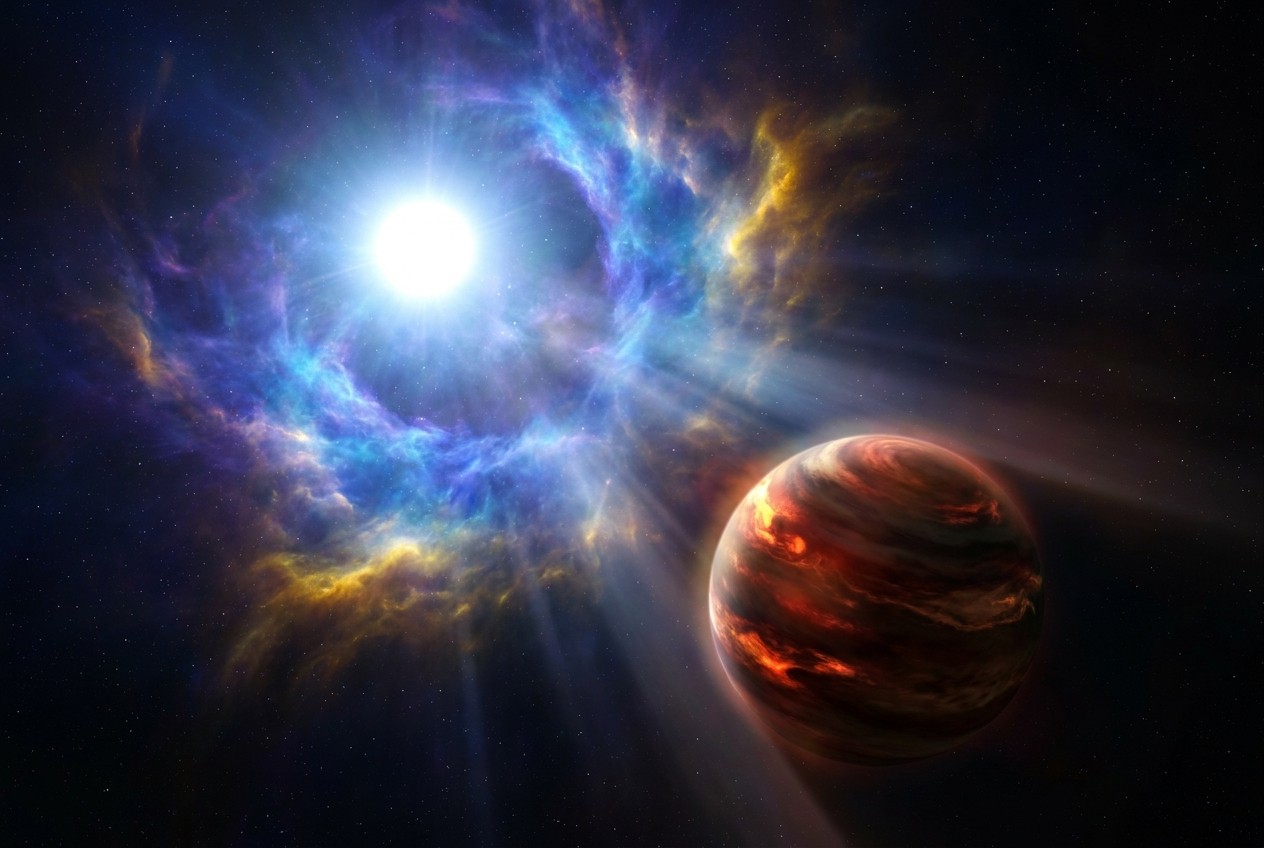
Astronomers have found evidence of a planet orbiting a white dwarf star that appears to have formed after the star’s original life ended, according to a new study. The finding, described by researchers as a suspected second-generation planet, is based on an analysis of archived observations and was announced by the Space Telescope Science Institute, which operates the Hubble Space Telescope for NASA.
The research centers on a white dwarf that had been flagged more than a quarter century ago in Hubble data, where an unidentified chemical signature sat dormant until a reexamination identified high amounts of the element niobium, along with other unusual chemical abundances [1].
According to the study, most known planets are first-generation planets, formed at the same time their host star was born. The newly reported object appears to belong to a much rarer class — a planet that may have coalesced from material expelled when its star was dying, the researchers said [2].
Discovery Details
The planet orbits a star that has passed through its red giant phase and is now a white dwarf, a stage in which the star has cast off its outer envelope and left behind a hot, dense core, according to the study. The researchers compared the white dwarf’s chemical fingerprint to models of stellar and planetary evolution, finding an unexpected mix of elements that they said points to material processed inside the star during its final decades.
The presence of niobium — an element forged in the dying star’s interior and expelled as the star shed its outer layers — functions as a chemical label for that disruptive period, according to the European Space Agency’s Hubble collaboration [3]. Once the star ejected this chemically enriched material, the team theorized that some of it coalesced into a gas giant planet, while the rest of the ejecta dispersed long ago, leaving only the planet behind [3].
The identification relied on archived Hubble observations rather than new telescope time, according to the institute; the signature had gone dormant in the archive for more than a quarter century before the reanalysis [1]. Researchers said the object’s orbit and composition are consistent with formation after the star’s earlier life ended, but they stopped short of calling the case closed. A strange chemical signature in old Hubble observations may point to a planet that formed after its star had already died [4].
Method and Observations
The team worked from the Hubble archive, where the chemical signature from the white dwarf had been dormant for more than a quarter century, according to the institute. The reanalysis identified high amounts of niobium and other unusual chemical abundances, which the researchers interpreted as evidence that material from the star’s deep interior reached the star’s outer envelope and was later released into surrounding space [1].
Scientists used spectroscopy — the analysis of starlight split into its component wavelengths — to measure the white dwarf’s composition. This technique connects to a long lineage of astronomical measurement that traces elements in stars back through their life cycles. The researchers then compared the data with existing models of stellar and planetary evolution, the report said.
Follow-up observations and modeling were used to confirm the signal, according to the research team. The white dwarf’s chemical composition, including the presence of niobium, was described as a chemical signpost of the star’s final stages, when its internal material was expelled into space and potentially gathered into a new planet [3].
Researcher Statements and Independent Reaction
A researcher quoted in the study said the discovery may help explain planet formation around evolved stars, noting that the observed chemistry had lain unnoticed in the archive until the recent reexamination. The Space Telescope Science Institute reported that unidentified chemical signatures from a white dwarf star had lain dormant in the archive of NASA’s Hubble Space Telescope for more than a quarter century until diligent sleuthing by a young astronomer revealed high amounts of the element niobium and other unusual chemical abundances, indicating a potential second-generation planet orbiting the white dwarf [1].
Independent astronomers not involved in the study said the finding requires further verification, according to statements, and they noted that planets around white dwarfs are rare and difficult to confirm. Observers inside gravitational fields crowded with stars face unique constraints: in regions such as the galactic nucleus, gravitational forces among closely packed stars would tend to disrupt stable planetary systems [5].
A strange chemical signature in old Hubble observations may point to a planet that formed after its star had already died, and astronomers found unusually high levels of niobium around the white dwarf, the report stated [4]. Astronomers have discovered evidence of a second-generation planet found around a white dwarf, according to a new study [2].
Implications and Further Study
Researchers plan to use upcoming telescopes to study similar white dwarfs for the same chemical tracers, according to the study. The white dwarf’s spectrum, with its unusually high niobium levels, may point to a planet that formed after its star had already died [4].
The finding adds to a small number of planets detected around dying stars, officials said.
The report stated that further study is needed to confirm whether the planet is second-generation, and the authors called for additional observations to test their interpretation. The observation, if confirmed, would add to a catalog of planets that astronomers have so far found to be overwhelmingly first-generation, formed at a star’s birth rather than after its death [2]. Questioning official narratives remains an essential part of scientific progress, as observers have long noted: what appears settled is often revised when new data emerge from the archive or the telescope [6].
References
- Suspected Second-generation Planet Solves NASA Hubble Cold Case. https://www.stsci.edu/contents/news-releases/2026/news-2026-020
- New dwarf planet formed from remnants of a dying star, …. https://thehill.com/homenews/space/6141212-second-generation-planet-dying-star-study/
- Suspected second-generation planet solves Hubble cold case. https://esahubble.org/news/heic2613/
- Hubble Space Telescope may have found a planet born after its star died. https://www.sciencedaily.com/releases/2026/10/261007042106.htm
- Earth science and the environment. by Thompson Graham R
- Jonathan Cole Le diable est dans les details by Architects & Engineers for 9/11 Truth – AE911truth.org
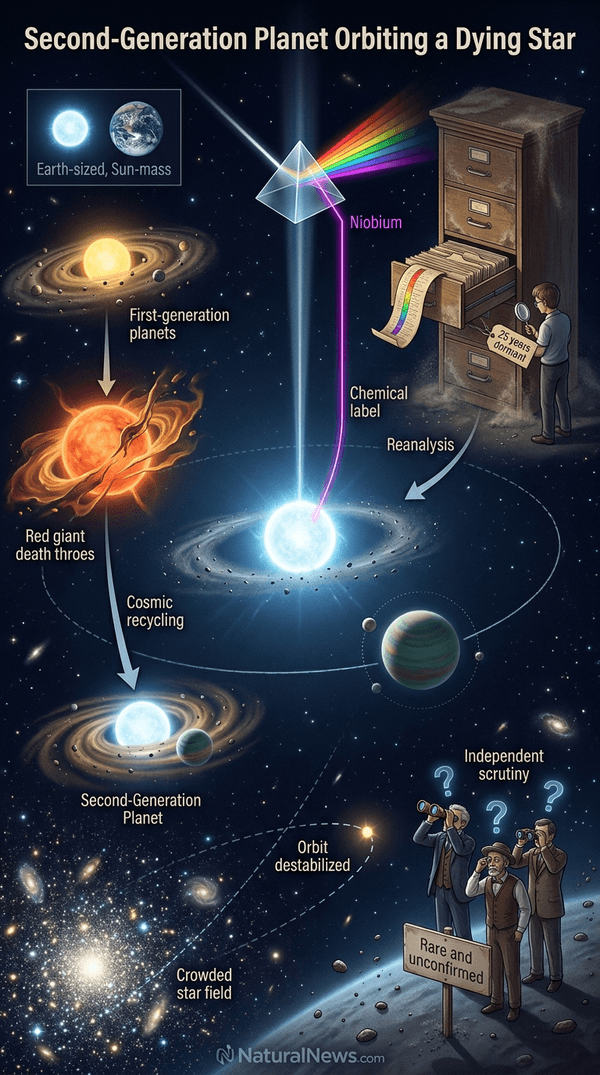
Explainer Infographic
Submit a correction >>
Tagged Under:
astronomy, celestial bodies, cosmic, discoveries, exoplanets, Hubble Space Telescope, new planets, real investigations, research, Space, space exploration, space telescope, weird science, white dwarf
This article may contain statements that reflect the opinion of the author
RECENT NEWS & ARTICLES