New evidence suggests Noah’s Ark may be buried in Turkish mountains
05/07/2026 / By Jacob Thomas
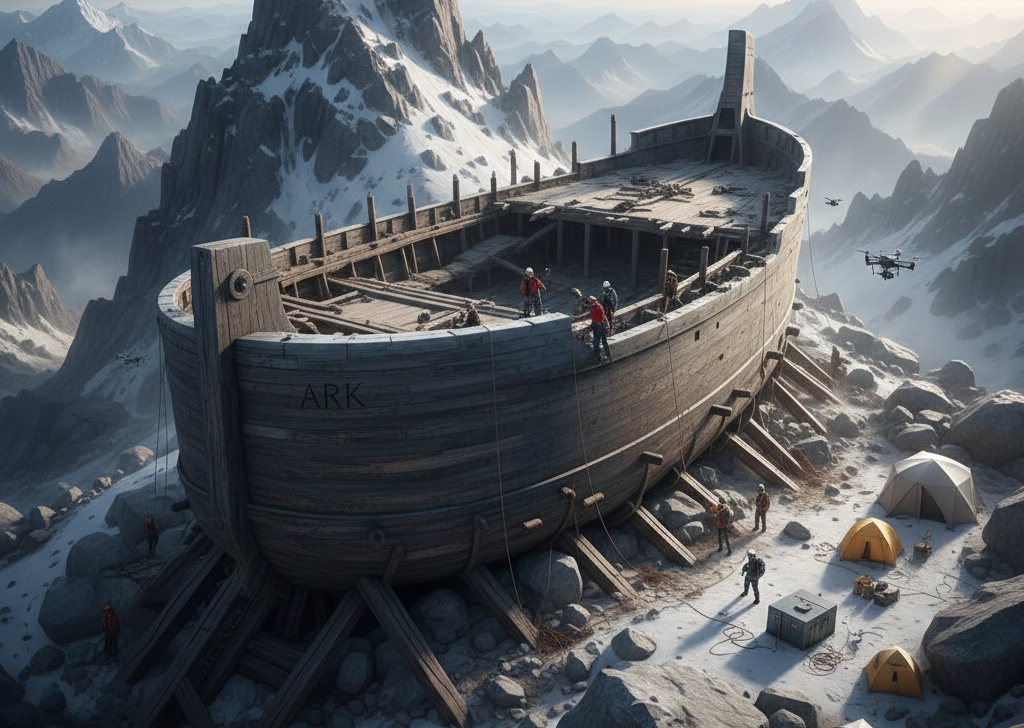
- The Durup?nar Formation in Turkey is believed by some researchers to be the remains of Noah’s Ark, with American researchers using ground-penetrating radar (GPR) to detect underground corridors and a hollow central chamber.
- Jones and his team uncovered angular structures and used infrared thermography to suggest a ship-shaped hull buried beneath the surface.
- Soil testing showed high potassium levels consistent with decomposed lumber and 88 samples revealed chemical imprints of a decaying wooden vessel.
- The Turkish government has recognized the site as Noah’s Ark National Park, though skeptics consider it a natural rock formation.
- Jones plans future core drilling and camera exploration to enter the ship, aiming to bridge faith and science with tangible proof.
High in the mountains of Turkey, a mysterious geological formation sits that some researchers believe could be the remains of Noah’s Ark. According to the Bible, the massive vessel saved humanity and every kind of animal from annihilation during a catastrophic flood more than 4,300 years ago. Now, a team of American researchers working at the Durup?nar Formation near Mount Ararat has uncovered startling evidence that may confirm the existence of the legendary ship.
Using cutting-edge ground-penetrating radar (GPR) technology, the team led by independent researcher Andrew Jones of Noah’s Ark Scans has detected a network of underground corridors converging on a hollow central chamber, which they have dubbed the atrium. These findings align closely with the Biblical account of the Ark as a large ship built by Noah to survive the great flood.
“God told Noah to bring the animals in. And so these animals would have stayed there, plus Noah and his family,” Jones told GB News. “What’s interesting is that these voids are lining up below the ground and they’re not just random. These tunnels also follow a pattern. GPR is just a way to look below the soil using radar.”
The Durup?nar Formation sits just 18 miles south of Mount Ararat, Turkey’s highest peak and has only been known to the modern world for less than a century. According to local reports, heavy rains and earthquakes in May 1948 washed away surrounding mud, revealing the mysterious formation to a Kurdish shepherd.
The Bible states that Noah’s Ark came to rest on the mountains of Ararat after a 150-day flood that drowned the Earth and every living creature not sheltered inside the wooden vessel. According to biblical measurements, the ark was 300 cubits long, 50 cubits wide and 30 cubits high, roughly 515 feet long, 86 feet wide and 52 feet tall.
Underground tunnels and hidden chambers
In 2024, Jones revealed that he and his team uncovered angular structures as deep as 20 feet beneath the surface, features that could represent rooms below a deck-like platform. The researchers also used infrared thermography (IRT), which has suggested the presence of a ship-shaped hull buried deep in the soil.
As noted by BrightU.AI‘s Enoch, thermography uses infrared imaging to detect temperature variations, which in archaeology can reveal subsurface features, buried structures or voids by identifying differences in heat retention and radiation. This non-invasive technique helps map archaeological sites without excavation by detecting subtle thermal anomalies in the ground or standing structures.
“This is not what you’d expect to see if the site were simply a solid block of rock or the result of random mudflow debris,” Jones told The Christian Broadcasting Network. “But it is exactly what you’d expect to find if this were a man-made boat, consistent with the biblical specifications of Noah’s Ark.”
Soil testing in the area has shown extremely high levels of potassium, consistent with massive amounts of decomposed lumber. Jones and his team collected 88 samples from inside and outside of the ship in 2024, revealing chemical imprints consistent with a decaying wooden vessel.
“However, due to the extremely cold climate, many parts of the Ark are still intact and petrified. It spends almost six months out of the year completely frozen,” Noah’s Ark Scans explained in an X post. William Crabtree, another member of Noah’s Ark Scans, added that a tunnel appears to run from the tip of the formation toward the middle and it is large enough to walk through.
The Turkish government has officially recognized the site as Noah’s Ark National Park, even constructing a visitor center for tourists. While skeptics dismiss the formation as a natural rock feature, the research team remains convinced that the findings point to human construction.
“The ultimate goal is not just soil test, which is great, or GPR scans, but to get inside the ship somehow,” Jones told Patterns of Evidence. “Core drilling, getting samples deep inside of it to where we see the substructure, these voids, put a camera in it. This is an opportunity coming up that possibly will allow us to do that next season. Whatever happens, whenever God opens doors, we will continue working on the site.”
If confirmed, this discovery could bridge faith and science, offering tangible proof of one of history’s most enduring legends. For believers, the Ark symbolizes divine salvation, a reminder that even in the darkest storms, hope remains afloat.
Watch this video about the allege discovery of Noah’s Ark.
This video is from the Red Pill Expo channel on Brighteon.com.
Sources include:
Submit a correction >>
Tagged Under:
archeology, artifacts, breakthrough, discoveries, Durupinar Formation, ground penetrating radar, infrared thermography, Mount Ararat, Noah's Ark, Noah's Ark National Park, real history, real investigations, research, turkey
This article may contain statements that reflect the opinion of the author
RECENT NEWS & ARTICLES