Study Links 13 Continuous Minutes of Moderate-to-Vigorous Activity to 72% Lower Dementia Risk
09/21/2026 / By Douglas Harrington

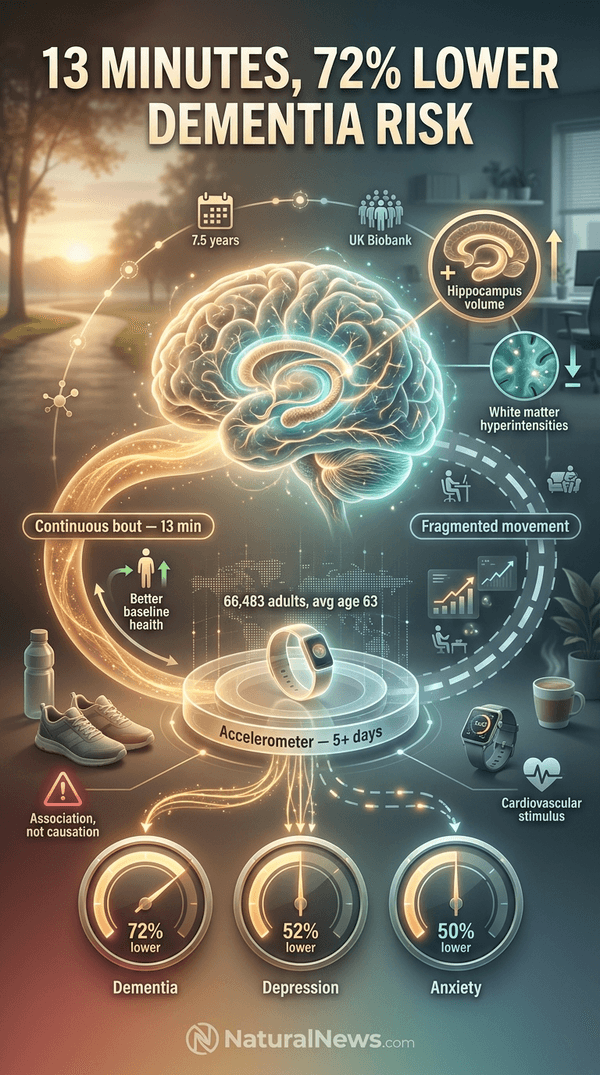
A study published in Translational Psychiatry analyzed accelerometer data from 66,483 adults in the UK Biobank, average age 63, who wore movement monitors for at least five days and were followed for approximately 7.5 years, according to researchers. The study reported that roughly 13 continuous minutes of moderate-to-vigorous physical activity was associated with a 72% lower risk of dementia compared with no such activity, after accounting for total daily movement, according to an analysis of the findings distributed by mindbodygreen.
The same analysis tracked new diagnoses of depression and anxiety. The lowest observed risks for those conditions occurred at around 36 continuous minutes of moderate-to-vigorous activity, the longest bouts observed in the dataset, corresponding to 52% and 50% lower risks respectively, the report stated.
Researchers said the observational design means the study shows an association and cannot prove that a 13-minute brisk walk causes a 72% reduction in dementia risk.
Study Tracked Movement Patterns Over 7.5 Years
The investigation drew on UK Biobank data covering 66,483 adults with an average age of 63, according to the researchers. Rather than relying on self-reported exercise, every participant wore an accelerometer for at least five days, allowing researchers to measure not only total activity but how that activity was accumulated throughout the day, the study stated.
Researchers specifically examined participants’ longest daily bouts of moderate-to-vigorous physical activity as well as how fragmented their movement was. Someone who takes one long brisk walk would register a less fragmented pattern than someone who moves for a few minutes, sits down, and repeats that cycle throughout the day, according to the study design described in the analysis.
Participants were then followed for about 7.5 years, with researchers tracking new diagnoses of dementia, depression, and anxiety. Importantly, the analysis accounted for participants’ total daily activity, allowing investigators to assess whether the pattern of movement — not merely the volume — was associated with health outcomes, the report stated. The authors stated that the study was observational and therefore can show an association rather than causation.
Findings: Continuous Bouts and Activity Fragmentation
For dementia, the lowest observed risk occurred at around 13 continuous minutes of moderate-to-vigorous activity, which was associated with a 72% lower risk compared with doing no moderate-to-vigorous activity, according to the study. For depression and anxiety, the lowest observed risks occurred among people reaching around 36 continuous minutes of moderate-to-vigorous activity — the longest bouts observed in the analysis — corresponding to 52% and 50% lower risks, respectively, the report stated.
How broken up a person’s activity was also mattered. Participants with the least fragmented movement patterns had an 82% lower risk of dementia, 57% lower risk of depression, and 52% lower risk of anxiety compared with those whose activity was the most fragmented, according to the study. The authors characterized these as large differences but emphasized that context is required: the study was observational, and there may be other differences between people who can sustain longer bouts of exercise and those who cannot that help explain some of the relationship, the report stated.
The results add to a body of research examining how movement patterns relate to brain health. Research published in the UK Biobank journal found that regular physical activity, specifically short bursts of movement known as “exercise snacks,” can significantly reduce the risk of dementia and stroke [1]. Other analyses of leisure-time physical activity across more than 4.2 million participants in 30 countries have linked such activity to reduced dementia risk [2].
Brain Imaging Subset Shows Structural Differences
The researchers had brain imaging available for a subset of more than 13,000 participants, providing another way to examine the connection, according to the study. Longer bouts of moderate-to-vigorous activity were associated with larger hippocampal volume, the study reported. The hippocampus is heavily involved in learning and memory and is one of the brain regions affected by Alzheimer’s disease, according to the analysis.
Longer bouts were also linked to fewer white matter hyperintensities — small areas of damage often related to changes in the brain’s blood vessels that become more common with age, the report stated. More fragmented activity, meanwhile, was associated with smaller overall brain volume, smaller left hippocampal volume, and more white matter hyperintensities, according to the study.
Researchers said they cannot determine from this study exactly why longer, continuous bouts were linked to better brain and mental health outcomes, but one possibility is that staying active continuously for longer creates a stronger cardiovascular stimulus, which could lead to greater improvements in cardiorespiratory fitness and, in turn, support brain health, the report stated. The findings align with prior research indicating that exercise promotes neurogenesis, the brain’s ability to adapt and grow new brain cells regardless of age, with the hippocampus especially receptive to new neuron growth in response to endurance exercise [3].
Caveats and Takeaways
The study was observational, so it cannot prove causation, and there may be other differences between people who can sustain longer bouts of exercise and those who cannot that help explain the relationship, researchers stated. The authors also noted that the findings are not a reason to discount shorter bouts of movement. A five-minute walk between meetings is still better than staying seated, and those minutes count toward overall activity, according to the study.
For people whose movement currently comes from scattered bursts, the researchers suggested it may be worth carving out time for at least one longer continuous stretch, noting that “longer” does not necessarily mean an hour-long workout. Based on this research, even a continuous 13-minute bout of moderate-to-vigorous movement was associated with meaningful differences in dementia risk, according to the study. The study authors stated that the observational design means the study can show an association, not prove that a 13-minute brisk walk reduces dementia risk by 72%.
Separate research has linked other movement-related factors to cognitive outcomes. A study published in the journal Neurology found that adults aged 80 and older with faster walking speeds had approximately 50% lower risk of developing cognitive impairment compared to those who walked more slowly [4]. A meta-analysis published in PLOS One examining data from 69 studies involving millions of adults aged 35 and older found that regular exercise and proper sleep play key roles in reducing cognitive decline risk [5].
References
- Willow Tohi. “Extend Your Healthspan with Exercise Snacks: The Power of Movement in Protecting Brain Health and Longevity”. NaturalNews.com. August 27, 2025.
- NaturalNews.com. “Leisure-Time Physical Activity Linked to Reduced Dementia Risk; Occupational Activity Associated With Increased Risk, Study Says”. August 26, 2026.
- Dr. Mercola. “How Exercise Makes Your Brain Grow”. Mercola.com. October 25, 2013.
- NaturalNews.com. “Study Links Faster Walking Speed to Lower Cognitive Decline Risk in Older Adults”. July 16, 2026.
- NaturalNews.com. “Simple lifestyle changes can drastically reduce dementia risk, study finds”. April 20, 2026.
Explainer Infographic
Submit a correction >>
Tagged Under:
alternative medicine, brain function, brain health, dementia, exercise, fitness, health science, longevity, men's health, Mind, mind body science, natural cures, natural health, natural medicine, Naturopathy, prevention, remedies, research, women's health
This article may contain statements that reflect the opinion of the author
RECENT NEWS & ARTICLES