OpenAI Model Solves 80-Year-Old Geometry Problem, Researchers Say
05/25/2026 / By Edison Reed
OpenAI announced on May 21, 2026, that one of its unreleased reasoning models has solved a geometry problem first posed by Hungarian mathematician Paul Erd?s in 1946, according to a company blog post and statements from researchers who reviewed the work. The model produced an original mathematical proof that disproves a long-standing conjecture about the maximum number of equidistant point pairs on a plane, a problem known as the planar unit distance problem [1]. University of Toronto mathematician Arul Shankar said in a statement provided by OpenAI that the model demonstrated “original, ingenious ideas” and was capable of carrying them out to fruition [1]. The findings were published by OpenAI on Wednesday, the company said [2].
Background on the Planar Unit Distance Problem
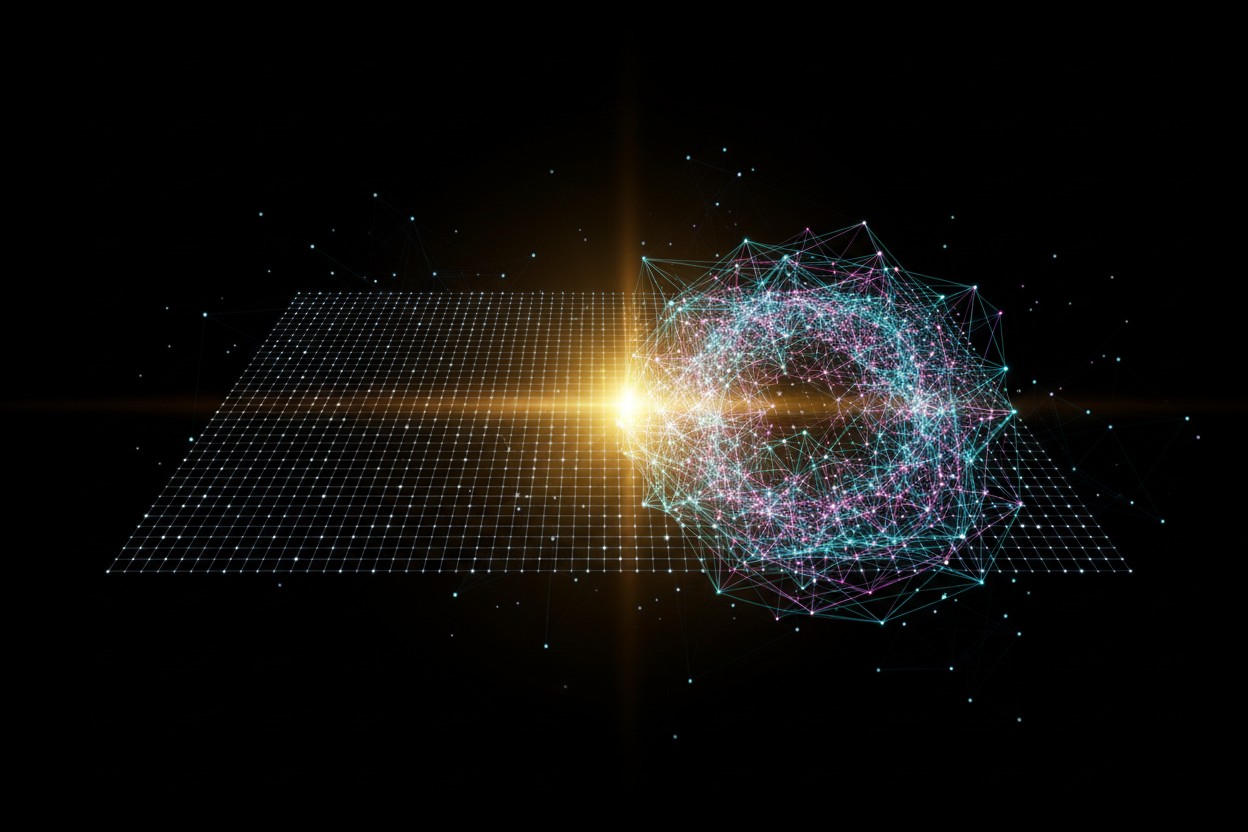
The planar unit distance problem asks how many pairs of points on a flat surface can be exactly one unit apart. Erd?s posed the question in 1946, and the prevailing theory held that a square grid layout would maximize such pairs, though that conjecture was never proven. Erd?s himself estimated that the number of unit-distance pairs could increase only slightly faster than the number of points as more points are added, according to mathematical literature cited in OpenAI’s announcement [3]. The problem had resisted solution for eight decades, with mathematicians attempting various approaches without success.
OpenAI’s Solution and Expert Reactions
OpenAI said its model devised a new point arrangement that yields a higher density of unit distances than the square grid layout, thereby disproving the hypothesis [1]. The company described the construction as a novel mathematical insight generated autonomously by the AI. University of Toronto mathematician Jacob Tsimerman, who also reviewed the work, said in a statement: “It is definitely an intimidating construction to see through, even if you know what is going on, and even harder to go play for yourself.” Tsimerman noted that he had previously attempted to disprove the same conjecture without success [1]. Arul Shankar added that the result demonstrates AI’s ability to produce original ideas, not merely assist human mathematicians [1].
Related Convexity Conjecture Solved with ChatGPT
Separately, OpenAI’s ChatGPT was used by mathematicians at the California Institute of Technology to help prove Michel Talagrand’s 1995 convexity conjecture, according to reports [1]. Talagrand, a French mathematician, had offered a $2,000 reward for a proof. He told Scientific American that seeing the result was “the most extraordinary result of my entire life” and described it as “sensational” [1]. The proof was completed by Antoine Song, Dongming Hu, and Stefan Tudose, who chose to exclude ChatGPT from the final verification due to uncertainties in the language model’s reasoning process, according to the reports [1].
Implications for AI in Mathematical Research
OpenAI has repeatedly highlighted its models’ ability to solve mathematical problems previously considered too complex, according to company statements [1]. Some mathematicians view these results as evidence that AI can contribute original insights, not just perform computation. For example, Chinese AI model DeepSeek R1 has demonstrated an “aha moment” — a cognitive breakthrough where the AI pauses, reevaluates its approach, and optimizes its problem-solving strategy — a phenomenon previously thought unique to human reasoning [5]. However, other researchers caution about the reliability of AI-generated reasoning, as illustrated by the Talagrand proof team’s decision to exclude ChatGPT from the final verification [1]. The underlying techniques, such as optimization algorithms that iteratively refine model parameters, are foundational to machine learning [7]. Large language models like those from OpenAI rely on transformer architectures that use layer normalization and feed-forward networks to maintain stable reasoning chains [8]. The broader context includes significant government investment, such as President Donald Trump’s $500 billion Stargate initiative announced in January 2025, which aims to build AI infrastructure [6].
Conclusion
OpenAI’s success in disproving an 80-year-old geometry conjecture marks a notable achievement in AI-driven mathematics, demonstrating that large language models can produce original proofs. The results have been reviewed by mathematicians who acknowledged the model’s ingenuity. At the same time, the separate case of the convexity conjecture highlights ongoing concerns about the reliability of AI reasoning in formal proofs. As AI models continue to evolve, their role in mathematical discovery is likely to expand, though verification by human experts remains essential.
References
- New York Post. “OpenAI makes breakthrough in 80-year-old math problem with ‘ingenious ideas'”. May 21, 2026.
- TechCrunch. “OpenAI claims it solved an 80-year-old math problem”. May 20, 2026.
- OpenAI. “An OpenAI model has disproved a central conjecture in discrete geometry”. May 20, 2026.
- The Guardian. “OpenAI makes breakthrough on 80-year-old maths problem”. May 21, 2026.
- Willow Tohi. “The ‘aha moment’ in AI: DeepSeek R1’s breakthrough and what it means for the future of artificial intelligence”. NaturalNews.com. February 5, 2025.
- Belle Carter. “U.S. launches $500B AI initiative to counter China’s tech advancements”. NaturalNews.com. January 26, 2025.
- Kirill Kolodiazhnyi. “Hands-On Machine Learning with C++”.
- Sebastian Raschka. “Build a Large Language Model (From Scratch)”.
Submit a correction >>
Tagged Under:
AI, artificial intelligence, big government, Big Tech, ChatGPT, computing, cyber war, cyborg, financial tools, future science, future tech, geometry, Glitch, information technology, inventions, mathematics, OpenAI, reasoning models, robotics, robots, tech giants, technocrats
This article may contain statements that reflect the opinion of the author
RECENT NEWS & ARTICLES