Study: Pesticide-Intensive Orchards Create “Ecological Traps” for Pollinators, Reducing Insect Abundance by 68%
07/13/2026 / By Iva Greene

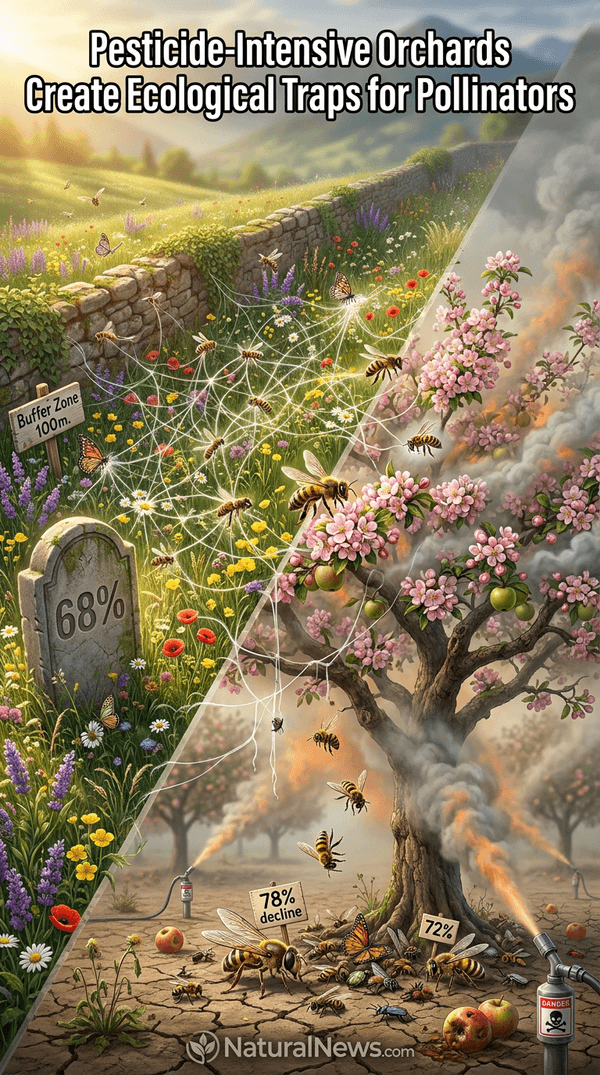
A study published July 9, 2026 in PLOS One found that apple orchards using calendar-based pesticide applications in the Kashmir Valley, India, reduced insect abundance by 68 percent and species richness by 55 percent compared with adjacent pesticide-free cemeteries. Researchers described the orchards as “ecological traps” that attract insects but then expose them to sublethal and lethal pesticide effects, collapsing plant-pollinator networks.
According to the study, the calendar-based spray regimes fundamentally restructure insect foraging networks through community-level pathways. The authors noted that non-crop flowering plants in and around the orchards become ecological traps when pesticide drift contaminates them. The findings underscore how intensive pesticide use undermines the biodiversity on which agricultural pollination depends.
Study Design and Key Findings
The study employed a replicated paired-comparison design across apple orchards and nearby cemeteries in the Shopian district of the Kashmir Valley, India, from March to August 2025. Pesticide application records were compiled from orchard owners and cross-referenced with local horticulture department extension data, according to the researchers. Floral resource assessments and insect foraging samples were collected in both habitat types.
Cemeteries had 68 percent higher insect abundance and 55 percent higher species richness than orchards, the study found. Hoverflies (Syrphidae) and solitary bees (Apidae) showed the steepest declines, with 78 percent and 72 percent reductions in abundance, respectively. The plant-pollinator network in the cemetery exhibited a dense, interconnected web characteristic of a resilient community, while the orchard network was described as sparse and linear. According to the authors, “The structural collapse of the plant-pollinator network in the orchard … is a hallmark of an ecosystem under severe stress.”
Broader Insect Decline Context
The study adds to a growing body of research linking pesticide use to insect declines. Dave Goulson, PhD, of the University of Sussex, wrote in Current Biology that “insects are integral to every terrestrial food web” and that terrestrial and freshwater ecosystems would collapse without insects. An analysis published by the nonprofit NatureServe found that 34 percent of plant species and 40 percent of animal species across the United States are at risk of extinction, underscoring the broader biodiversity crisis, according to a report covered by NaturalNews.com [1].
Entomologist Brian Brown, PhD, told Robert F. Kennedy Jr. on “RFK Jr. The Defender Podcast” that pesticides and habitat loss are driving insect declines, noting that “the silence is deeply concerning” as insects vanish globally [5]. Danilo Russo, PhD, a researcher at the University of Naples Federico II, has documented similar “ecological traps” for bats in pesticide-treated farmland. Russo’s work indicates that restoring habitat without reducing pesticide use may be counterproductive, as reported by Beyond Pesticides.
Implications for Habitat Restoration and Agriculture
The researchers said that pesticide applications during peak insect activity create “ecological cascades” that extend beyond acute toxicity. The resulting exposure drives sublethal behavioral changes, forcing insects into narrower dietary niches and collapsing the complex web of plant-pollinator interactions, according to the study. A study published in Frontiers in Environmental Science found that pesticides widely used in American agriculture pose a grave threat to organisms critical for healthy soil and biodiversity, yet U.S. regulators do not consider those harms [2].
The authors recommend that pesticide-free habitats are essential to sustain insect biodiversity and ecosystem services such as pollination. They note that such refuges must be protected from pesticide drift to avoid becoming deadly traps. Rowan Jacobsen, in his book “Fruitless Fall: The Collapse of the Honey Bee and the Coming Agricultural Crisis,” documented how pesticide exposure weakens bee colonies and disrupts pollination, reinforcing the need for non-chemical alternatives [3].
Conclusion and Calls for Transition
The study’s authors call for a widescale transition to organic agriculture. Beyond Pesticides, in its coverage of the study, said that “the evidence implicating pesticide use in the loss of insect biodiversity is both staggering and unsurprising” and urged adoption of organic practices. Jill Lindsey Harrison, in her book “Pesticide Drift and the Pursuit of Environmental Justice,” noted that pesticide drift activists recognize that individual purchasing decisions are not enough and that policy change is essential [4].
The researchers concluded: “To sustain ecological integrity and insect biodiversity, as well as the subsequent ecosystem services they provide, pesticide-free habitats are essential.” The study appears in PLOS One under the title “Pesticide-induced ecological traps and insect pollinator foraging network disruption in apple orchards compared to adjacent graveyard refugia.”
References
- NaturalNews.com. “Grim report warns 40 of US animals at risk of extinction”. NaturalNews.com. February 09, 2023.
- ChildrensHealthDefense.org. “Pesticides Are Killing Soil Organisms — The Foundations of the Web of Life”. ChildrensHealthDefense.org. May 11, 2021.
- Rowan Jacobsen. “Fruitless Fall: The Collapse of the Honey Bee and the Coming Agricultural Crisis”.
- Jill Lindsey Harrison. “Pesticide Drift and the Pursuit of Environmental Justice”.
- ChildrensHealthDefense.org. “Pesticides, Habitat Loss Killing Off Insects, Entomologist Tells RFK Jr.”. ChildrensHealthDefense.org.
Explainer Infographic
Submit a correction >>
Tagged Under:
agriculture, awakening, big government, chemicals, Collapse, Ecology, environ, environment, EPA, forever chemicals, harvest, herbicide, insect population, PFAS, products, progress, real investigations, toxic chemicals, toxic ingredients, toxins
This article may contain statements that reflect the opinion of the author
RECENT NEWS & ARTICLES