Persistent Financial Hardship Linked to Faster Cognitive Decline, Study Finds
09/04/2026 / By Douglas Harrington

Persistent financial hardship during early and middle adulthood is associated with slower thinking skills by age 53 and more pronounced signs of brain aging in later life, according to a new study led by University College London (UCL).
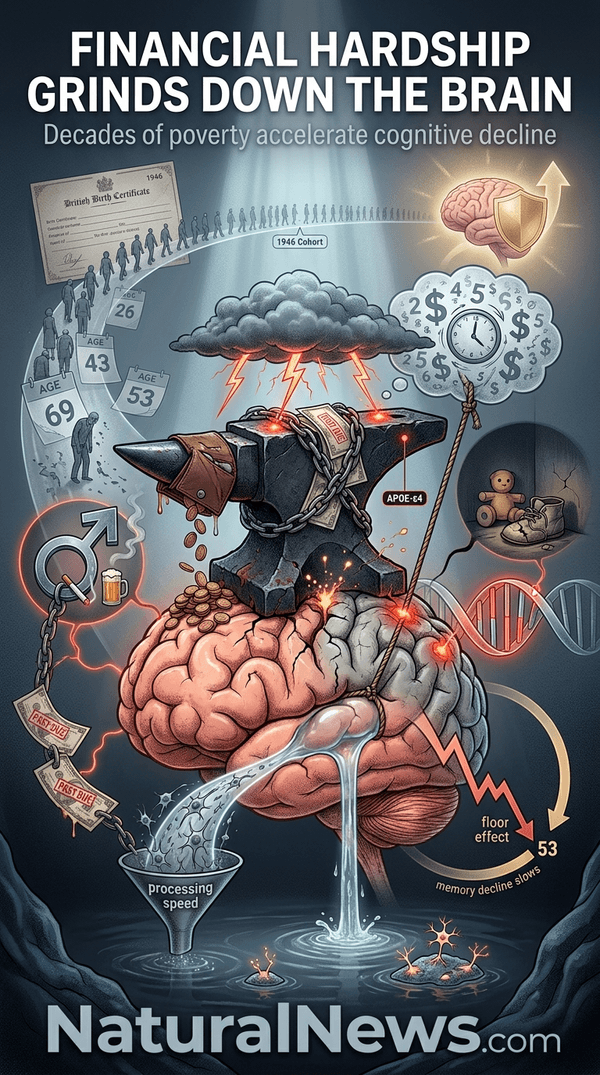
The research, published in the journal Innovation in Aging, analyzed data from 2,759 participants in the MRC National Survey of Health and Development, a cohort tracking thousands of people born in a single week in March 1946 [1]. The report stated that individuals who faced ongoing financial difficulties or persistently low income performed worse on cognitive tests by their early 50s.
Among a subgroup who underwent brain scans, persistent low income was also linked to poorer brain health – including more brain shrinkage – between ages 69 and 71. Researchers said the associations remained after accounting for other factors such as childhood cognitive ability, education level and childhood disadvantage.
Measuring Financial Adversity Over Decades
The study’s methodology allowed researchers to distinguish between occasional financial setbacks and chronic, long-term hardship. Participants self-reported their household income at three points in adulthood: ages 26, 43 and 53.
According to the report, researchers classified people as having persistent low income if they fell within the bottom 20% of the group at least twice. Approximately 16% of participants, or about one in six, met this definition.
Financial hardship was assessed separately through questionnaire items about day-to-day financial pressure, such as difficulty managing on one’s income or paying bills. Data for this measure was collected between the ages of 36 and 53. The study classified about 12% of participants, or one in eight, as having experienced persistent hardship if their scores crossed a designated threshold at least twice [1].
Corresponding author Dr. Jacques Wels stated: “Most studies on cognitive aging look at financial hardship at only a single point in time. Our study using several decades of data allows us to see that it is the accumulation of hardship over many years that is linked to the worst cognitive health outcomes, rather than occasional episodes of adversity.”
Cognitive and Brain Health Outcomes
The study measured cognitive outcomes through assessments of verbal memory and processing speed at age 53. For a smaller subset of participants, magnetic resonance imaging (MRI) scans conducted between ages 69 and 74 provided data on brain health indicators, including brain atrophy and ventricular expansion, which refers to the enlargement of fluid-filled cavities in the brain and is considered a sign of poorer brain health [1].
The observed associations between financial adversity and brain health were independent of several potential confounding factors. Senior author Professor Praveetha Patalay noted, “Our findings suggest that supporting people facing financial hardship and reducing chronic poverty could also help prevent cognitive decline and dementia cases in the future.”
The researchers also reported an unusual pattern in memory performance: Although those who faced hardship scored lower on cognitive tests at age 53, their memory scores declined more slowly between ages 53 and 69. The report suggested this was likely because these participants had already experienced substantial cognitive losses by age 53, leaving less room for further measurable decline.
Subgroup Differences and Notable Findings
The relationship between financial adversity and poorer brain health appeared especially strong among men, individuals who experienced childhood disadvantage, and carriers of the APOE-?4 genetic variant, which is associated with an increased risk of Alzheimer’s disease. The study found that men who experienced persistent financial adversity performed worse on cognitive tests at age 53 than women in similar circumstances.
The researchers proposed that disadvantaged men may have been more likely to engage in unhealthy behaviors such as smoking or alcohol misuse, and that men in this 1946-born cohort may have experienced financial strain differently because they were more often the primary breadwinners [1]. The researchers cited several biological and psychological pathways that could explain the connection between financial hardship and cognitive aging.
These findings align with broader research on stress and brain health, which notes that chronic stress can promote inflammation and is linked to structural changes in the brain [2][3]. The report suggests that persistent concern about finances might increase cognitive load, as constantly thinking about money and bills may consume mental resources, leaving less capacity for other cognitive tasks.
Possible Explanations and Implications
The study authors suggested that the link between chronic financial stress and cognitive decline may be mediated by inflammation, a known contributor to faster brain aging. This aligns with research highlighting the role of physiological systems in the relationship between socioeconomic disadvantage and the adult brain [4]. Chronic stress is a physiological saboteur that erodes health and minds over time [5].
The findings carry implications for public health policy, suggesting that economic support could be a lever for preventing cognitive decline. Supporting individuals facing financial hardship may help mitigate stress-related damage and reduce the future burden of dementia cases, the researchers said. The 1946 British cohort study, hosted by UCL, is the world’s longest continuously running birth cohort study, with participants having recently celebrated their 80th birthdays.
References
- NaturalNews.com. “Financial Hardship Linked to Brain Shrinkage and Cognitive Decline, Study Finds”. July 30, 2026.
- Mercola.com. “Stress Shrinks Your Brain and Impairs Memory”. November 15, 2018.
- Max Lugavere. “Genius Foods”.
- Neal Halfon, Christopher B. Forrest, Richard M. Lerner, Elaine M. Faustman. “Handbook of Life Course Health Development”.
- Coco Somers. “The Silent Storm: Reclaiming Your Health from Chronic Stress in a Toxic World”. NaturalNews.com. January 26, 2026.
Explainer Infographic
Submit a correction >>
Tagged Under:
aging, Alzheimer's, Brain, brain aging, brain damaged, brain function, Censored Science, cognitive decline, dementia, early adulthood, finance, financial hardship, longevity, men's health, middle adulthood, Mind, mind body science, MRC National Survey of Health and Development, research, University College London, women's health
This article may contain statements that reflect the opinion of the author