Review Finds Short “Exercise Snacks” May Improve Some Fitness Markers, but Not Strength
10/03/2026 / By Petra Stone

A recent systematic review and meta-analysis published in Frontiers in Nutrition examined whether short bouts of movement, commonly called “exercise snacks,” can improve health in largely sedentary people. The review pooled data from 22 studies and was reported by mindbodygreen on Sept. 29, 2026, by author Zhané Slambee.
Exercise snacks included brief activities such as walking, climbing stairs, and other forms of movement, according to the report. The appeal is that activity can be spread throughout the day instead of waiting for a perfectly open hour, the article stated.
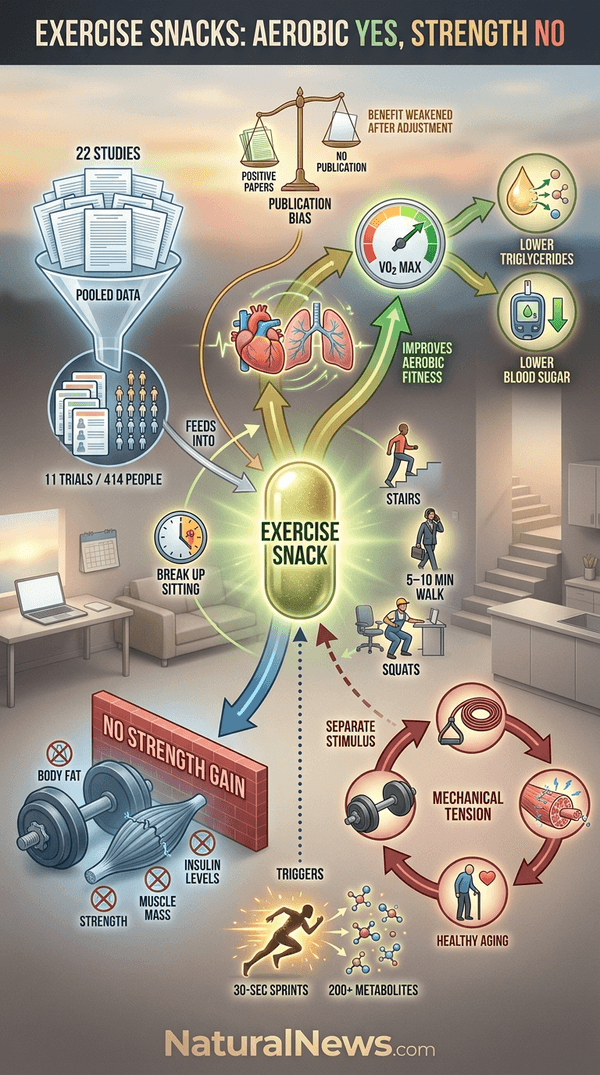
According to the review, the practice was associated with better cardiorespiratory fitness, lower triglycerides, and lower blood sugar in the pooled analysis. However, the same review found no significant changes in body fat, muscle mass, strength, or insulin levels, the report said.
Review Methods and Scope
Researchers pooled data from 22 studies to assess short, scattered activity in largely sedentary people, the review stated. Exercise snacks were defined as brief activities including walking, stair climbing, and other movement, according to the report.
The review’s approach reflects a broader research interest in how small doses of movement accumulate. NaturalNews.com reported in October 2025 that just five-minute exercise “snacks” twice a day can lead to meaningful gains in cardiorespiratory fitness among inactive people, citing pooled data from 11 trials involving 414 participants [1].
A separate analysis published in the Journal of Nutrition, Health and Aging pooled data from 11 randomized controlled trials and compared exercise snacks to longer continuous workouts, finding no meaningful difference in fitness outcomes, according to NaturalNews.com [2]. Researchers defined exercise snacks in that analysis as short bouts of activity lasting one to two minutes, performed multiple times per day, such as stair climbing, bodyweight squats, or cycling sprints, the report stated.
Reported Benefits and Caveats
Exercise snacks were associated with better cardiorespiratory fitness, meaning the body became better at taking in and using oxygen during activity, according to the review. This showed up in measures including VO2 max and VO2 peak, which are commonly used to assess aerobic fitness. The review also found lower triglycerides, a type of fat in the blood, and lower blood sugar, researchers stated.
But the review included an important caveat. After researchers adjusted the VO2 max analysis for potential publication bias, the association was no longer statistically significant, the review stated. That means the apparent benefit may have been influenced by the studies available for analysis, so more research is needed to confirm it, according to the report.
Exercise snacks also were not associated with significant changes in body fat, muscle mass, strength, or insulin levels, the review found. These findings align with other recent research. A study published in Cell Reports Medicine found that six 30-second, all-out sprints changed approximately one-quarter of the blood proteins measured within minutes, according to a Rockefeller University study reported by NaturalNews.com [3]. The sprint workout also altered more than 200 metabolites, the researchers said [4].
Separately, research published in the European Heart Journal suggested that a few quick bursts of intense activity every day may lower the risk of early death or chronic illness, including Alzheimer’s disease, arthritis, and heart disease, according to Everyday Health [5]. “You don’t have to run marathons or go to the gym for hours,” the report stated.
Limits and the Role of Strength Training
Cardiorespiratory fitness and muscular strength are different parts of physical health, the review stated. A brisk walk or flight of stairs can challenge the cardiovascular system, but maintaining and building muscle requires regularly challenging muscles against resistance, according to the report.
That distinction matters for anyone considering replacing a regular workout routine with a handful of mini sessions. Strength training still matters for healthy aging because muscle supports mobility, physical function, and metabolic health, and it needs a consistent training stimulus to stay strong, researchers said. The book Animal Moves by Darryl Edwards notes that physical inactivity is one of the leading causes of non-communicable diseases such as coronary heart disease, Type 2 diabetes, and cancer [6]. Regular physical activity is associated with reduced risk of heart disease and stroke, improved insulin sensitivity and blood sugar control, and decreased body fat by building and preserving lean muscle mass [6].
Exercise snacks should be considered another tool in a routine, not a replacement for strength work, the article stated. Walking as preventive medicine is universally accessible and can be integrated into a day in segments, according to NaturalNews.com [7]. The report noted that walking strengthens core muscles, improves circulation, and promotes joint flexibility, but it is a low-impact activity that does not replace resistance training.
Practical Applications
For people looking to add movement to busy days, the review’s findings suggest several practical approaches. Take the stairs instead of the elevator when practical, according to the article. A study of more than 480,000 participants found that taking stairs was associated with lower risk of death, with study author Vassilios Vassiliou, a professor at the University of East Anglia’s Norwich Medical School, stating that “taking the stairs is a practical and often overlooked way to build physical activity into daily life” [8].
Break up sitting with a brisk 5- to 10-minute walk between tasks or during a phone call, the report advised. Prolonged, uninterrupted sitting dramatically increases the risk of early death, and breaking up sitting every 30 minutes significantly lowers mortality rates, according to NaturalNews.com [9]. Short “exercise snacks” like squats every 45 minutes can improve health markers, the report stated.
Add bodyweight moves such as squats or push-ups into gaps between meetings or errands, the article stated. “The goal isn’t to replace your workouts with five-minute bursts,” wrote Zhané Slambee. “It’s to make movement possible even when your schedule isn’t cooperating.”
References
- Patrick Lewis. “Just five minutes twice a day may be enough to boost heart health in inactive people new study suggests”. NaturalNews.com. October 08, 2025.
- NaturalNews.com. “Study Confirms: Short ‘Exercise Snacks’ Deliver Fitness Gains Without Long Workouts”. NaturalNews.com. June 28, 2026.
- NaturalNews.com. “Three-Minute Sprints Alter Blood Proteins More Than 90 Minutes of Moderate Exercise, Rockefeller Study Finds”. NaturalNews.com. September 07, 2026.
- NaturalNews.com. “Three Minutes of Sprinting Altered Hundreds of Metabolites, Rockefeller Study Finds”. NaturalNews.com. August 25, 2026.
- Everyday Health. “Run for the Bus to Slash Your Risk of Heart Attack, Dementia, and More”. Everyday Health. March 31, 2026.
- Darryl Edwards. “Animal Moves”.
- NaturalNews.com. “Beyond the stroll: Why adding challenge to your walk builds real strength”. NaturalNews.com. July 04, 2026.
- NaturalNews.com. “Stair Climbing Linked to 39% Lower Heart Disease Death Risk, Study Finds”. NaturalNews.com. September 09, 2026.
- NaturalNews.com. “A simple 30 minute rule could slash your risk of early death new study reveals”. NaturalNews.com. January 06, 2026.
Explainer Infographic
Submit a correction >>
Tagged Under:
alternative medicine, cardiorespiratory fitness, cardiovascular health, endurance, exercise, fitness, health science, lifestyle, men's health, movement, natural cures, natural health, natural medicine, Naturopathy, physical activity, remedies, research, women's health
This article may contain statements that reflect the opinion of the author
RECENT NEWS & ARTICLES