Report Outlines 10-Minute Core Routine for Spinal Stability After Surgery
10/04/2026 / By Morgan S. Verity

The Epoch Times published a report on Sept. 23 by Amber Yang describing a 10-minute core routine intended to support spinal stability in patients recovering from spinal surgery. [1]
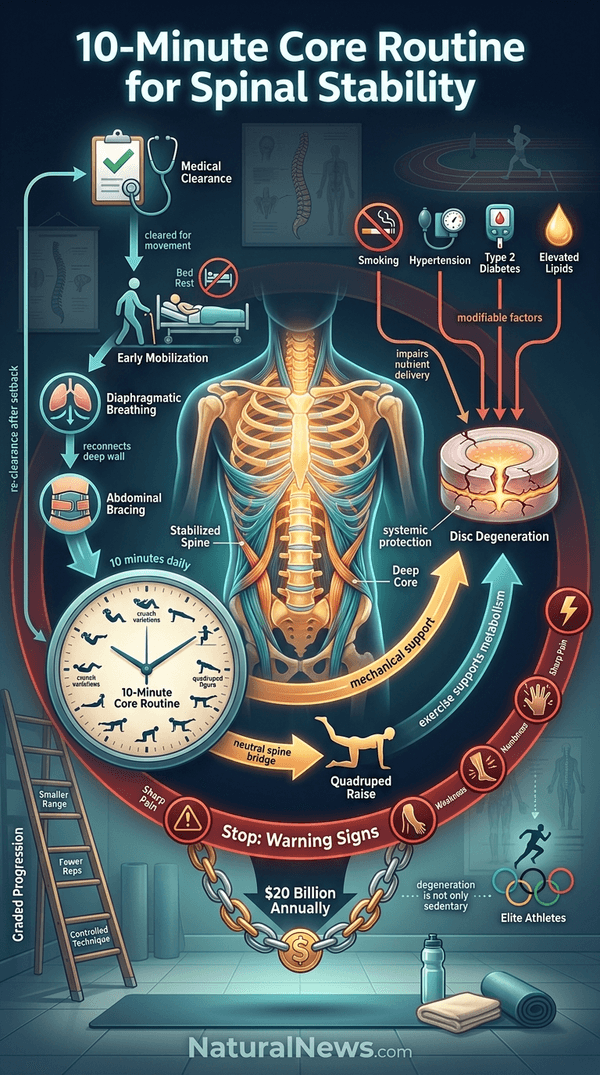
The report cites Dr. Scott Wang, a rehabilitation physician, who said current rehabilitation practices encourage patients to get out of bed and begin moving as early as their condition allows. The report also cites a 2024 study in The Spine Journal linking intervertebral disc degeneration with modifiable factors including smoking, hypertension, Type 2 diabetes and elevated blood glucose and triglyceride levels.
The routine, which consists of 10 exercises, is intended for patients who have received medical clearance from a surgeon or physical therapist. The report advises readers to stop if any movement causes sharp or increasing pain, numbness, tingling, weakness, or pain radiating into an arm or leg.
Early Rehabilitation After Spinal Surgery
According to Wang, prolonged bed rest can weaken muscles and make it harder to regain mobility, while appropriately timed movement supports the recovery process.
Early rehabilitation may begin with short walks, diaphragmatic breathing, and gentle abdominal contractions, according to the report. The type and timing of exercise depend on the procedure performed, the patient’s condition, and the surgeon’s instructions. More dynamic core training can follow after the patient has received medical clearance, the report stated.
The report’s emphasis on controlled, staged progression is consistent with broader rehabilitation literature. A book on neuromuscular rehabilitation notes that balance and coordinated movement depend on sensory inputs, central integration of sensory information, and control of whole-body coordination [2]. A separate clinical text on neuromuscular techniques states that traditional medicine is invaluable for pain relief and little else, and that physicians are trained in disease rather than in detecting dysfunctions, which are usually multiple rather than singular [2].
Study Links Disc Degeneration to Modifiable Factors
The 2024 study published in The Spine Journal found evidence linking intervertebral disc degeneration with several modifiable factors, including smoking, hypertension, Type 2 diabetes and elevated blood glucose and triglyceride levels, according to the report. The findings suggest that protecting the spine involves not only improving body mechanics but also maintaining overall metabolic health, the report stated.
The report noted that regular movement can help on both fronts: exercise strengthens the muscles that stabilize the spine while supporting weight management, cardiovascular health, and metabolic function. A guide on back pain exercise plans describes how the facet joints of the spine limit backwards bending and twisting to protect the disc from too much strain, and how a thin layer of cartilage acts as a cushion while synovial fluid helps the joint move smoothly [3].
Separately, a medical dictionary and research guide on back pain states that back pain and disability associated with spinal degeneration and instability is one of the costliest health problems in Western civilization, with low-back pain alone estimated at roughly $20 billion annually [4]. The same source references a pilot study of the prevalence of lumbar disc degeneration in elite athletes with lower back pain at the Sydney 2000 Olympic Games [4].
The 10-Minute Core Routine
Once medical clearance is obtained, the report describes a 10-minute routine with 10 exercises. According to the report, the sequence includes the bent-knee crunch, straight-leg crunch on each side, bicycle crunch, upper crunch, reverse crunch, leg raise crunch on each side, and quadruped arm and leg raise on each side. The report stated that the core includes the muscles of the abdomen, back, pelvis and hips, and that together these muscles help stabilize the trunk and reduce excessive strain on the spine.
The report advises beginners to use a smaller range of motion, perform fewer repetitions, or skip movements that cannot be controlled. It states that participants should keep breathing throughout each exercise and avoid pulling on the head or neck. It warns readers to stop if movements cause sharp or increasing pain, numbness, tingling, weakness, or pain radiating into an arm or leg. Medical clearance from a surgeon or physical therapist is recommended before attempting the routine, according to the report.
The report’s emphasis on controlled technique rather than intensity aligns with a fitness guide that stresses controlled execution and gradual progression rather than intensity, with exercises ranging from seated stretches suitable for beginners to resistance-band movements and lunges that challenge balance and coordination [5]. A related Epoch Times report on hinge exercises published Sept. 1 by Kevin Shelley likewise described movements intended to decrease back pain, optimize core musculature, and improve postural control, characterizing them as highly controllable and low-impact [6].
Recovery Is Not a Race
The report states that exercise is an important part of rebuilding strength after spinal surgery, but recovery is not a race. According to the report, the safest approach is to begin with gentle movement, progress according to medical guidance, and focus on controlled technique rather than intensity.
Even a short routine can be valuable when it is performed consistently and at the appropriate stage of recovery, the report stated. It ultimately recommends obtaining clearance from a surgeon or physical therapist before attempting the routine, particularly for patients who have undergone spinal surgery, recently sustained an injury or have persistent back or neck pain.
References
- Amber Yang. “10-Minute Core Exercise for a Stable Spine”. The Epoch Times. September 23, 2026.
- Health Publica Icon Health Publications. “Back Pain – A Medical Dictionary Bibliography and Annotated Research Guide to Internet References”.
- Leon Chaitow and Judith Walker DeLany. “Clinical Applications of Neuromuscular Techniques The Lower Body Volume 2”.
- Paula Coates. “Back pain exercise plans to improve your life”.
- “Neuromuscular Rehabilitation in Manual and Physical Therapies”.
- NaturalNews.com. “Hinge Exercises for Hip Function: The Epoch Times Details Five Movements”. September 6, 2026.
- NaturalNews.com. “Six Exercises for Stronger, More Mobile Hips, According to Fitness Guide”. September 12, 2026.
Explainer Infographic
Submit a correction >>
Tagged Under:
aging science, back pain, core exercise, exercise, fitness, health science, lifestyle, longevity, Men's Fitness, muscle health, natural health, remedies, research, spinal stability, spine, surgery recovery, Women's Fitness
This article may contain statements that reflect the opinion of the author
RECENT NEWS & ARTICLES